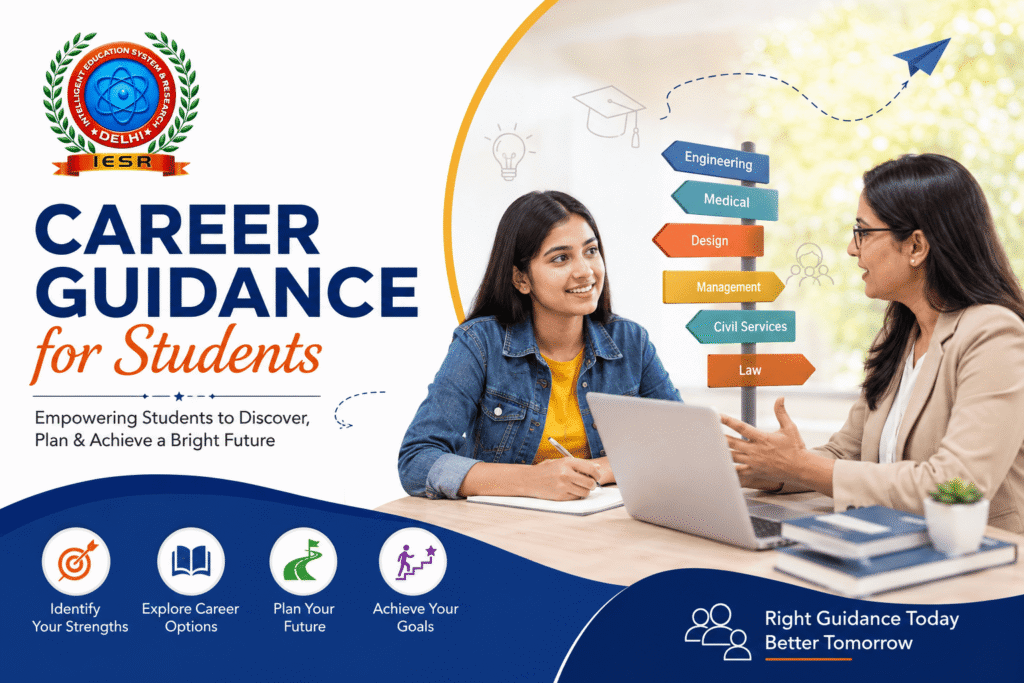
Choosing the right career is one of the most important decisions in a student’s life. With hundreds of career options available today, students often feel confused about which course, stream, or profession is right for them. Career guidance for students can help them understand their interests, abilities, strengths, and career opportunities so they can make informed decisions about their future.
At IESR Foundation, we believe that every student deserves access to the right information and guidance to build a successful and meaningful career. Proper career counselling can help students explore different possibilities, understand their potential, and develop a clear career plan.
What Is Career Guidance for Students?
Career guidance for students is a structured process that helps students identify suitable educational and career opportunities based on their interests, skills, abilities, personality, and goals.
Career guidance may include:
- Understanding a student’s interests and strengths
- Exploring different career options
- Selecting the right academic stream
- Choosing suitable courses and educational programs
- Understanding career opportunities
- Developing short-term and long-term career goals
- Preparing for higher education and employment
- Building essential employability skills
The goal is not to tell a student what career they must choose. Instead, career guidance helps students understand their options and make confident decisions.
Why Is Career Guidance Important for Students?
Many students choose careers because of peer pressure, family expectations, social trends, or incomplete information. This can sometimes result in dissatisfaction and uncertainty later.
Professional career guidance can help students make decisions based on their own interests and capabilities.
1. Helps Students Understand Their Strengths
Every student has different abilities. Some may be good at communication, while others may have strong analytical, creative, technical, or leadership skills.
Career counselling helps students identify these strengths and understand how they can be connected to potential career paths.
2. Provides Information About Career Options
Students are often familiar with traditional careers but may not know about emerging professions.
Career guidance can introduce students to areas such as:
- Information technology
- Digital marketing
- Data science
- Artificial intelligence
- Design and creative careers
- Healthcare
- Education
- Finance
- Entrepreneurship
- Skilled trades
- Social development
- Research and innovation
Understanding different career options allows students to make better-informed choices.
3. Helps in Choosing the Right Academic Stream
Choosing a stream after Class 10 is an important decision for many students. Science, Commerce, and Humanities can lead to different educational and professional opportunities.
Career guidance can help students understand the subjects, courses, entrance requirements, and career possibilities associated with different streams.
4. Reduces Career Confusion
Students may feel overwhelmed when they have too many options or do not know where to start.
A structured career guidance process can provide a clear direction and help students create realistic goals.
5. Builds Confidence
Making an informed career decision can improve a student’s confidence. When students understand why a particular career path suits their interests and abilities, they are more likely to work toward their goals with motivation.
When Should Students Seek Career Guidance?
Career guidance can be useful at different stages of education. It is not limited to students who are about to enter college.
After Class 8 or 9
Students can begin exploring their interests, strengths, and different areas of education without making an immediate career decision.
After Class 10
This is an important stage because students often need to select an academic stream and subjects for higher secondary education.
After Class 12
Students may need help choosing a degree, diploma, vocational course, entrance examination, or professional program.
During College
College students can benefit from guidance related to internships, skill development, career specialization, higher education, and employment opportunities.
How Does Career Counselling Work?
A good career counselling process generally involves several steps.
Step 1: Understanding the Student
The counsellor first understands the student’s educational background, interests, abilities, goals, and concerns.
Step 2: Identifying Interests and Skills
Students may use assessments, discussions, activities, and self-evaluation exercises to understand their strengths and areas of interest.
Step 3: Exploring Career Options
Based on the student’s profile, different career paths and educational opportunities can be explored.
Step 4: Understanding Educational Requirements
Students learn about the courses, qualifications, skills, entrance examinations, and educational pathways required for different careers.
Step 5: Creating a Career Plan
A practical plan can then be developed with short-term and long-term goals.
Step 6: Reviewing Progress
Career goals can change as students gain new experiences and discover new interests. Regular guidance can help them adjust their plans when necessary.
Benefits of Career Guidance for Students
Effective career guidance can provide several benefits:
- Better understanding of personal strengths
- Greater awareness of career opportunities
- Improved academic decision-making
- Reduced career-related confusion
- Better selection of courses and subjects
- Increased confidence
- Goal-oriented learning
- Improved employability awareness
- Better preparation for higher education
- Development of a long-term career plan
Role of Parents in Career Guidance
Parents play an important role in a student’s career journey. However, career decisions should ideally be based on the student’s interests and abilities rather than pressure.
Parents can support students by:
- Listening to their interests
- Encouraging them to explore different careers
- Providing reliable career information
- Avoiding comparisons with other students
- Supporting their educational goals
- Encouraging skill development
- Allowing students to participate in career counselling
A supportive family environment can help students make confident and responsible career decisions.
Career Guidance and Skill Development
Academic qualifications alone may not always be enough to succeed in today’s competitive environment. Students also need practical and soft skills.
Career guidance can encourage students to develop skills such as:
- Communication
- Problem-solving
- Teamwork
- Leadership
- Digital literacy
- Time management
- Critical thinking
- Adaptability
- Interview skills
- Resume preparation
Developing these skills early can help students become better prepared for higher education and future employment.
Common Career Mistakes Students Should Avoid
Students can sometimes make career decisions without adequate information. Some common mistakes include:
Choosing a Career Because of Friends
A career that is suitable for one student may not necessarily be suitable for another.
Following Trends Without Research
Popular careers can change over time. Students should research career requirements, opportunities, growth potential, and their own suitability before making a decision.
Ignoring Personal Interests
Interest and motivation can play an important role in long-term career satisfaction.
Selecting a Course Without Understanding Career Opportunities
Before choosing a course, students should understand what skills and career opportunities it can provide.
Relying Only on Social Media
Social media can provide ideas but should not be the only source of career information. Students should use reliable educational and professional resources.
How IESR Foundation Supports Career Guidance
IESR Foundation works toward creating educational and development opportunities for students and young people. Through career guidance and counselling, students can receive support in understanding their interests, exploring career possibilities, developing skills, and planning their future.
Our approach focuses on helping students make informed decisions rather than simply recommending a particular career.
Whether a student is choosing a stream after Class 10, selecting a course after Class 12, or preparing for future employment, proper guidance can provide valuable direction.
Conclusion
Choosing a career is a journey, not a single decision. Students need accurate information, self-awareness, practical skills, and the confidence to explore different opportunities.
Career guidance for student can help young people understand their potential, explore suitable career paths, choose appropriate educational opportunities, and prepare for a successful future.
With the right guidance and support, students can make informed career decisions and take meaningful steps toward achieving their goals.
IESR Foundation is committed to supporting students through education, career guidance, skill development, and opportunities for personal and professional growth.
Frequently Asked Questions (FAQs)
1. What is career guidance for students?
Career guidance for students is a process that helps students understand their interests, abilities, strengths, educational options, and potential career opportunities so they can make informed career decisions.
2. Why is career guidance important for students?
Career guidance helps students reduce confusion, understand different career options, choose suitable courses and subjects, set goals, and develop skills needed for their future.
3. When should students start career guidance?
Students can begin exploring their interests and career options from middle or secondary school. More structured guidance can be especially useful after Class 10 and Class 12.
4. How does career counselling help students?
Career counselling helps students understand their strengths and interests, explore suitable career options, learn about educational requirements, and create a practical career plan.
5. Can career guidance help students choose the right course?
Yes. Career guidance can help students compare different courses and understand how their interests, abilities, educational goals, and career plans relate to available courses.
6. What skills should students develop for their careers?
Students can develop communication, digital literacy, problem-solving, teamwork, leadership, critical thinking, time management, adaptability, and other employability skills.
7. Is career guidance only for Class 10 and Class 12 students?
No. Career guidance can benefit students at different educational stages, including school students, college students, and young people preparing for employment.