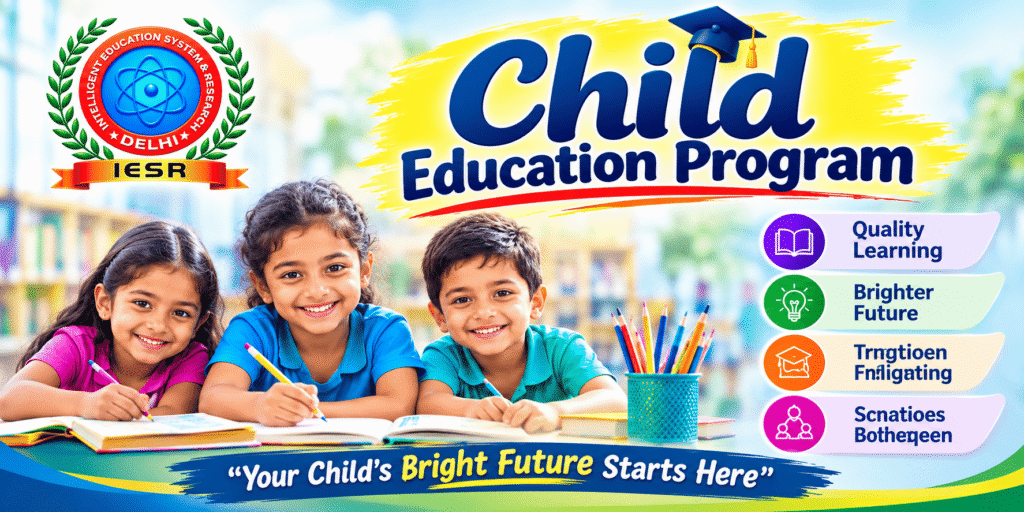
Child Education Program
Education is the foundation of a better future. Every child deserves the opportunity to learn, grow, and develop the skills needed to lead a successful life. A Child Education Program helps children gain access to quality education, develop confidence, improve literacy, and build essential life skills that prepare them for future success.
At IESR Foundation, we believe that education is the most powerful tool for breaking the cycle of poverty. Through our Child Education Program, we work to ensure that children from underserved communities receive equal opportunities to learn and achieve their dreams.
What is a Child Education Program?
A Child Education Program is a structured initiative designed to provide children with access to quality learning opportunities. These programs focus on academic education while also promoting emotional, social, and personal development.
The main objective is to ensure that every child, regardless of their financial background, has access to education in a safe and supportive environment.
Why Child Education is Important
Education shapes a child’s future in many ways.
1. Improves Literacy and Learning
Children develop reading, writing, mathematics, and communication skills that form the foundation of lifelong learning.
2. Builds Confidence
Education encourages children to express themselves, solve problems, and participate actively in society.
3. Reduces Poverty
Educated children have better employment opportunities in the future, helping families improve their quality of life.
4. Promotes Equality
Quality education helps bridge social and economic gaps by providing equal opportunities to all children.
5. Supports Overall Development
Children learn teamwork, creativity, leadership, discipline, and critical thinking alongside academics.
Objectives of Our Child Education Program
The Child Education Program at IESR Foundation aims to:
- Improve access to quality education.
- Support children from economically weaker families.
- Encourage regular school attendance.
- Strengthen foundational literacy and numeracy.
- Promote digital literacy and life skills.
- Reduce school dropout rates.
- Empower children through holistic learning.
- Encourage parental involvement in education.
Key Features of IESR Foundation’s Child Education Program
Quality Learning Support
We provide educational resources and guidance to help children perform better academically.
Skill Development
Along with classroom learning, children participate in activities that improve creativity, communication, and problem-solving.
Career Awareness
Older students receive career guidance to help them make informed educational choices.
Digital Learning
Technology-based learning enables children to develop essential digital skills for the modern world.
Community Participation
We work closely with parents, schools, volunteers, and local communities to create a positive learning environment.
Who Can Benefit from Our Child Education Program?
Our program is designed for:
- School-going children
- Children from underprivileged communities
- Rural and urban disadvantaged children
- First-generation learners
- Children needing academic support
- Students requiring career guidance
Benefits of Joining a Child Education Program
Children participating in educational programs experience numerous benefits:
- Better academic performance
- Increased confidence
- Improved communication skills
- Enhanced creativity
- Stronger problem-solving abilities
- Better school attendance
- Greater career awareness
- Improved social and emotional development
How IESR Foundation Creates Impact
IESR Foundation works to improve children’s lives through:
- Educational support initiatives
- Skill development activities
- Career counselling
- Community engagement
- Volunteer-driven learning programs
- Awareness campaigns promoting education for all
Our mission is to ensure that every child has access to opportunities that help them learn, grow, and become responsible citizens.
How You Can Support Child Education
You can contribute to creating a better future by:
- Donating to child education initiatives
- Sponsoring educational resources
- Volunteering your time and expertise
- Supporting community education programs
- Spreading awareness about the importance of education
Every contribution helps transform the life of a child.
Why Choose IESR Foundation?
IESR Foundation is committed to improving education through inclusive and community-focused initiatives.
Our strengths include:
- Child-centered learning approach
- Experienced mentors and volunteers
- Skill development opportunities
- Career counselling support
- Community-driven educational programs
- Focus on long-term social impact
Together, we can help every child unlock their full potential.
Conclusion
A Child Education Program is more than just classroom learning—it is an investment in the future of children, families, and society. By ensuring access to quality education, we empower children with the knowledge, confidence, and skills they need to build successful lives.
IESR Foundation remains dedicated to creating equal educational opportunities and helping every child achieve their dreams through education, skill development, and community support.
Frequently Asked Questions (FAQs)
Q1. Child education program 2022
The Child Education Program 2022 refers to educational initiatives and schemes introduced or continued during 2022 to improve children’s access to quality education, reduce school dropouts, and strengthen foundational learning. Many NGOs, including IESR Foundation, continue similar efforts to support children’s education today.
Q2. Free Education Scheme for child
Several Free Education Schemes for children are available in India through government initiatives such as the Right to Education (RTE) Act, Samagra Shiksha, PM POSHAN (Mid-Day Meal Scheme), scholarships, and various state-level education programs. NGOs also provide free educational support, learning materials, and skill development opportunities.
Q3. Early Childhood Care and Education courses
Early Childhood Care and Education (ECCE) courses prepare teachers, caregivers, and education professionals to support children from birth to around eight years of age. These courses cover child psychology, learning methods, nutrition, health, classroom management, and child development. ECCE is recognized as a crucial foundation for lifelong learning under India’s National Education Policy (NEP).
Q4. Government schemes for child education in India
Some important Government schemes for child education in India include:
- Right to Education (RTE) Act
- Samagra Shiksha
- PM POSHAN (Mid-Day Meal Scheme)
- National Means-cum-Merit Scholarship (NMMS)
- Kasturba Gandhi Balika Vidyalaya (KGBV)
- National Initiative for Proficiency in Reading with Understanding and Numeracy (NIPUN Bharat)
- Early Childhood Care and Education (ECCE) initiatives under the National Education Policy
These schemes aim to improve access, equity, nutrition, foundational literacy, and the overall quality of education for children across India.